



Contact: Efrat Dallal Stein: [email protected]
Cook County Department of Public Health Encourages Residents to Test Their Homes During Radon Action Month
Free Radon Test Kits Available for Suburban Cook County Residents
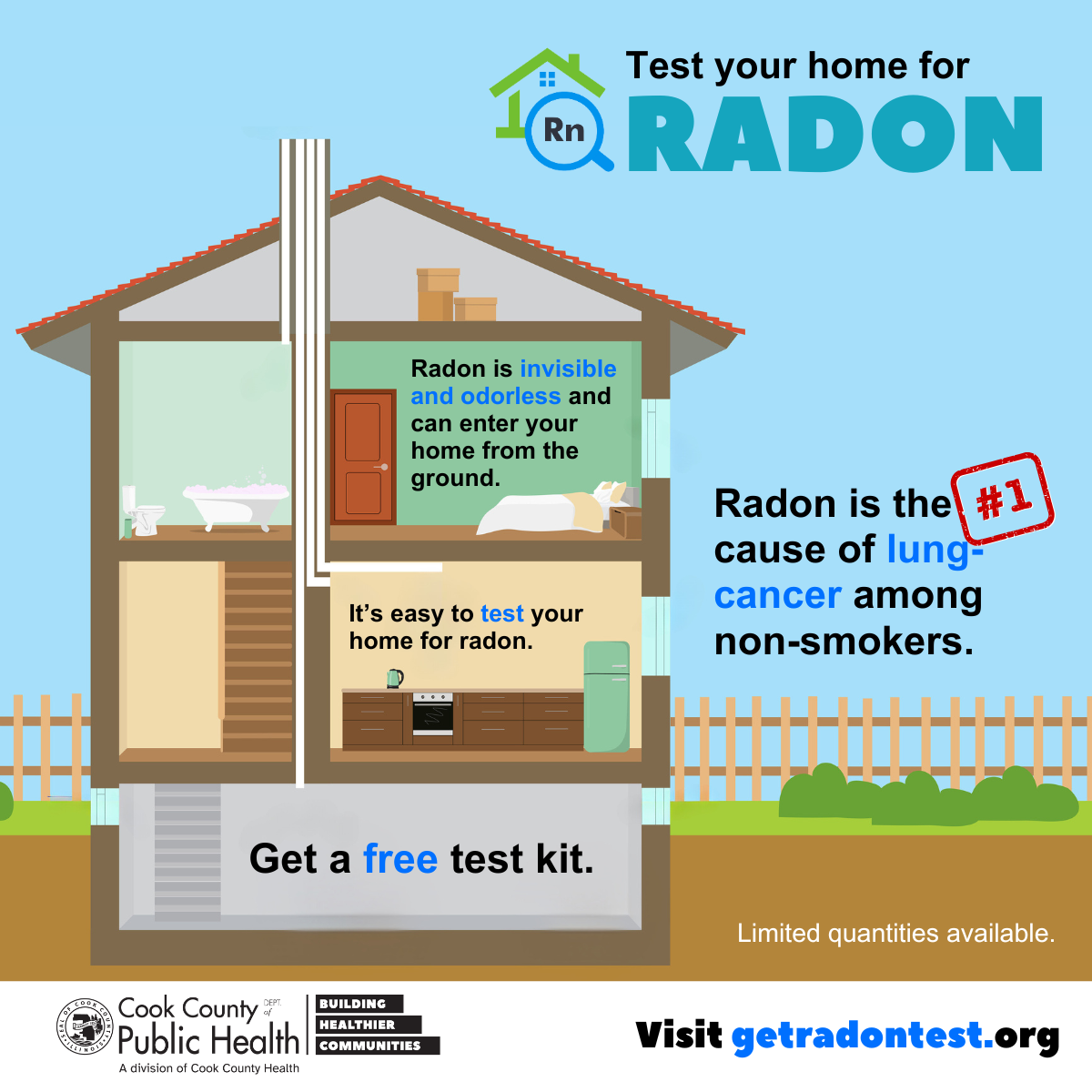
Bridgeview, IL. — Cook County Department of Public Health (CCDPH) is recognizing Radon Action Month by urging residents, no matter where they live, to test their homes for radon, a radioactive, colorless, and odorless gas that can cause lung cancer.
Radon is the second leading cause of lung cancer in the United States (after smoking) and responsible for an estimated 21,000 lung cancer deaths in the U.S. each year, according to the U.S. Environmental Protection Agency (EPA). It can accumulate to dangerous levels inside homes without any noticeable signs. The only way to know if radon levels are high is to test your home.
CCDPH offers free radon test kits to suburban Cook County residents. At-home radon test kits are free and easy to use and can be lifesaving.
“Radon is a silent threat, but it is preventable,” said Dr. Kiran Joshi, chief operating officer of CCDPH. “Testing your home is simple, and if high levels are detected, there are effective ways to reduce exposure and protect your health. We encourage all suburban Cook County residents to take this important step.”
Radon forms naturally from the breakdown of uranium in soil, rock, or water. It can seep into homes through:
- Cracks in the foundation or basement floor
- Gaps around pipes, cables, or utility lines
- Construction joints where walls meet floors
- Crawl spaces or dirt floors
Once inside, radon often accumulates in basements and lower levels, increasing long-term health risks. “Many people don’t realize that their home could have elevated radon levels, even if their neighbor’s home does not,” Dr. Joshi added. “Testing is the only way to know.”
If test results show a radon level of 4 picocuries per liter or higher, residents should consider taking steps to reduce exposure. Also consider taking action if levels are between 2-4 picocuries per liter. Reducing exposure may include sealing cracks in floors or foundations or installing a ventilation system designed to lower radon levels.
Key Facts about Radon:
Radon can be a problem anywhere. Elevated radon levels have been found in homes across all 50 states. That is why it is important for everyone, no matter where they live to test their home for radon.
Radon can affect people who don’t smoke. Even non-smokers are at risk for lung cancer from long-term radon exposure. Radon is the second leading cause of lung cancer in the United States after smoking.
Radon has no immediate symptoms. There are no immediate symptoms. Over time, exposure increases lung cancer risk. Symptoms may include chronic cough, shortness of breath, or chest pain.
Testing is the only way to know if you have radon. Testing is the only way to know if you have radon in your home and if you do, radon can be fixed by taking steps to reduce exposure like sealing cracks or installing ventilation. It is safe to buy a home with radon as long as proper mitigation is in place.
Request your free radon test kit today: Radon Test Kit Request – Cook County Department of Public Health
Questions about Radon test kits and removal can be sent to [email protected].
For more information about radon and lung cancer risk, visit the CDC radon education page: https://bit.ly/2S9itPT, or visit Radon | US EPA.
###
Cook County Department of Public Health, an affiliate of Cook County Health, is the nationally accredited, state-certified local health department serving suburban Cook County. We build healthier, more equitable communities by protecting health, preventing disease, engaging communities, and analyzing and sharing data for action.